

Birth of a union
External threats show need for a statewide union
Upstate, New York State Teachers Association was dominant, with 105,000 members who were generally uneasy about the idea of professionals joining a union.
Downstate, United Teachers of New York held sway with about 72,000 members, professionals all, and firmly allied with the trade unions and the AFL-CIO.
Like feuding families, these two groups — still wrestling internally with questions of identity and purpose — battled for primacy. No blood was shed, but as the competition intensified, financial costs mounted, along with bitter feelings on both sides.
As a destructive war for members raged on, the early seventies were shaping up as the best of times and the worst of times for New York state educators. The majority of teachers were poorly paid, disregarded and lacking leverage — but the 1966 passage of the landmark Taylor Law had ignited the possibility of real change, granting all public employees the right to unionize and bargain collectively.
Hope was in the air as local groups of teachers voted to organize, usually along school district lines. This progress only intensified the competition over which umbrella group would prevail as the voice of educators statewide.
The power of solidarity
Elected UFT president in 1964, succeeding Charles Cogen, Al Shanker accelerated UFT’s rise to a position of power and influence in the city. “I understood very quickly,” Shanker said, “that nothing would change for the better unless teachers learned to take matters into their own hands.”

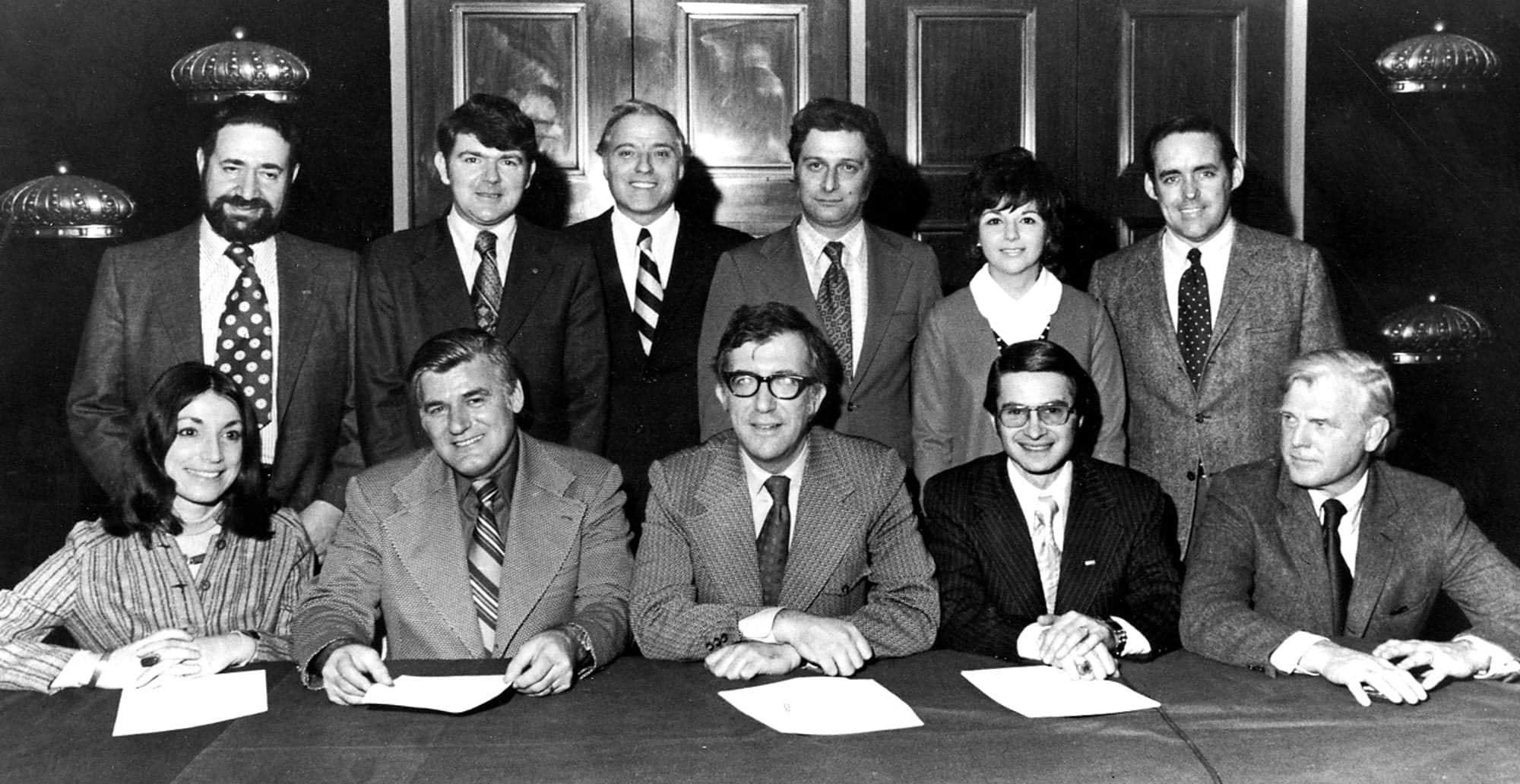
Union leaders Antonia Cortese, Tom Hobart and Al Shanker on the campaign trail to promote a statewide merger of rival teacher unions. Other union leaders who were active in crafting the merger included Ed Rodgers, Abel Blattman, Ken Deedy, Sandra Feldman, Dan Sanders and Walter Tice.
Meanwhile, Emanuel “Manny” Kafka of West Hempstead, “disgusted with how school employees were treated, the low salaries, the few benefits” in 1969 had been elected president of NYSTA. And while he bragged that NYSTA “was the only group at the Capitol” one fateful Friday in 1971 when brutal anti-teacher bills were put in motion, they, too, lacked the muscle to stop them.
Turf wars and talks of merger
In reality, they were more alike than they were different. Both helped their locals negotiate contracts, defended member rights and aligned on a host of educational issues. Their differences were fueled in part by distrust between upstate and downstate, divergent national affiliations, and a dispute over whether to link arms with the trade union movement and the AFL-CIO.
While they skirmished, external threats against teachers intensified. The 1971 bills had eroded teachers’ rights, increased the length of probation, eliminated minimum salaries and weakened tenure. Separately, teacher leaders were beginning to realize that if they wanted to effectively counter external threats, internal battles would have to stop.
It was Shanker, ever the visionary, who first pitched the idea of a statewide merger in talks with Kafka. At the time, the competitors had each taken parallel steps to strengthen their organizations. They had increased field services, legal support and member benefits and established unified dues structures. By 1972, Shanker and newly elected NYSTA President Tom Hobart of Buffalo made merger talks a priority.
Rival unions seek common ground
By forming the largest employee organization in New York state, Hobart declared, “teachers will now have the power to improve the quality of education for every child and to raise the status of the teaching profession.”
Sylvia Matousek, president of the North Syracuse EA, recalled: “That saying ‘all for one and one for all’ was just a saying for many of us when we thought about merger with the ‘radical’ downstaters. But having Tom there made us feel more secure … It was Tom’s reputation on the line with all the upstate locals.”
Founding officers, elected at the merged union’s first Representative Assembly in 1973, were Tom Hobart, president; Al Shanker, executive vice president; Dan Sanders, first vice president; Antonia Cortese, second vice president; and Ed Rodgers, secretary-treasurer. Members voted to adopt New York State United Teachers as the union’s official name. Decades later, after 33 years of achievement as NYSUT’s founding president, Hobart would say: “My part in that endeavor remains as my greatest achievement.” The new union was dually affiliated with the American Federation of Teachers and the National Education Association, and at the international level, with the AFL-CIO. It boasted a diverse membership, including teachers, guidance counselors, librarians, school-related personnel and public higher education faculty.
Growing pains
NEA, unhappy about the split affiliations, soon launched communications and organizing campaigns in New York state that were widely viewed as attempts to claw back locals and splinter the statewide organization. Just four years after it was inked, the fragile merger was in real trouble.


The growing tensions erupted at NYSUT’s 1976 Representative Assembly where it became clear that some locals were receptive to NEA’s pitch and planning to bail.
But how many? And could the statewide union even survive?
A galvanizing call to action
A legendary teacher leader, whose towering intellect and vision had propelled his New York City local to the forefront of power, Shanker had been one of the principal architects of statewide merger four years before. He took the mic.
As delegates hushed, Shanker’s voice slowed, and he told them a fable.
They were about to award the prize when a new competitor appeared. He was a lowbrow fellow, who carried in his hands, not a work of art, but a sledge hammer. He walked up to the clock and in three blows, destroyed it. And the people said, why, to smash up such a clock, this was surely the most unbelievable thing.
Shanker paused and addressed the delegates directly.
“Our organization is a wonderful work of art,” he said. “It has been put together. If destroyed, it will never be put together again.
“To each of us goes the responsibility of seeing that it is the clock that survives — and not the sledgehammer.”
The effect was galvanizing. Delegates roared to their feet in a prolonged standing ovation, some with tears streaming down their faces.
Another year would pass before the dust would settle, but as the 1976–77 school year drew to a close, it became clear NYSUT would lose just a fraction of the feared exodus. Its affiliation with the National Education Association ended, and it would be decades before the prospect of statewide unity would arise again.
But for now, the existential threat was over: The union survived. Looking back, many said that was the moment NYSUT truly came of age.
Timeline
-
1916Teacher unions in New York City; Chicago; Washington, D.C.; Scranton, Pa.; Gary, Ind.; and Oklahoma become the American Federation of Teachers, and are welcomed into the American Federation of Labor
-
1947Buffalo teachers walk out, the first major strike of educators in New York. NYS enacts the Condon-Wadlin Act requiring automatic dismissal of striking public employees.
-
1960The United Federation of Teachers forms in New York City.

-
1967The Taylor Law gives NYS public employees, including teachers, collective bargaining rights, but not the right to strike.
-
1967The United Federation of College Teachers negotiates the first public higher education collective bargaining agreement at Fashion Institute of Technology in New York City.

-
1972United Teachers of New York and New York State Teachers Association merge to form the New York Congress of Teachers (renamed NYSUT in 1973). The new union has dual affiliation with AFT and NEA. Al Shanker and Tom Hobart are co-presidents.
-
1972City University unions merge to form Professional Staff Congress (PSC).

-
1973Two higher education unions merge into SUNY/United, later renamed United University Professions.
