

NYSUT continues priorities push in state budget and legislative session
he release of the executive budget set the 2026 legislative session in Albany in full swing. Once again, NYSUT continues to work with its partners in government to make sure our schools are funded, our professions are protected, and our state remains a great place to live and raise a family.
The statewide union applauded the governor’s push to continue fully funding public schools. The executive budget proposal provides a total of $39.6 billion in school aid, a year-to-year increase of nearly $1.6 billion, and increasing the Foundation Aid funding formula by nearly $780 million. However, this Foundation Aid formula increase only represents a 1 percent increase for over 450 of the nearly 700 school districts across the state.
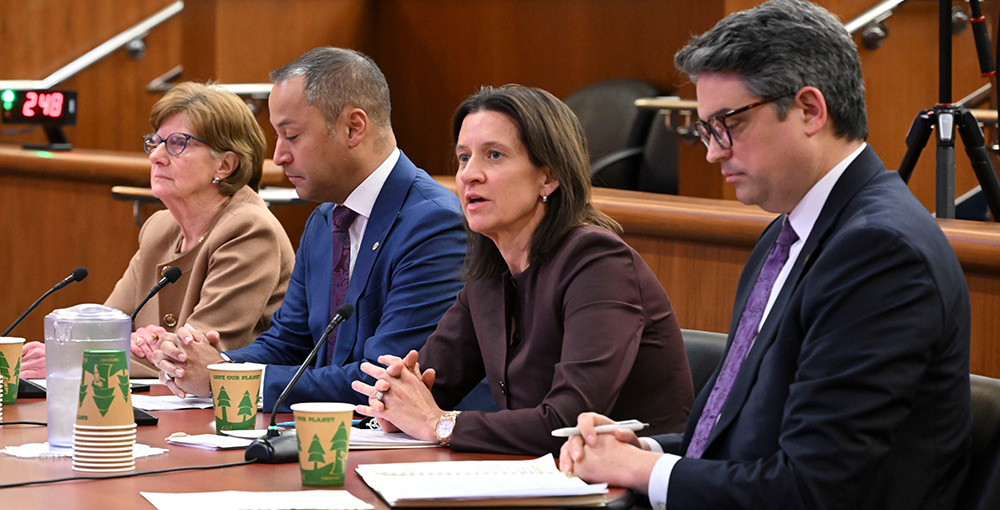
“This is a great start, but it is not enough to sustain our districts,” NYSUT President Melinda Person said during her budget testimony to the joint Assembly and Senate Education committees. Foundation Aid should be just that: a foundation, a starting point to build upon. NYSUT continues to call on the Legislature to increase the amount of Foundation Aid flowing to districts and to update the formula to represent the true cost of funding public schools.

NYSUT is also fighting for larger increases in higher education funding for SUNY and CUNY universities, colleges, hospitals and community colleges that have been starved for resources far too long.
“CUNY and SUNY are world-class institutions that open doors, fuel our economy, and serve as anchors for communities in every corner of New York,” said Person. “We must invest in them accordingly. When we strengthen public higher education, we strengthen opportunity, innovation, and the future of our state.”
NYSUT is seeking a $141.8 million increase in operating aid for SUNY campuses, above the governor’s proposed operating aid increase. In addition, the union is calling for increased aid for SUNY’s teaching hospitals, and aid to help SUNY ESF address its operating deficit. “We welcome the increase in operating aid that the governor has proposed. However, it’s not nearly enough,” said United University Professions President Fred Kowal.
For CUNY, NYSUT is requesting a $108 million increase in operating aid. “With the support of the Legislature, many of our colleges have begun to dig out of years of austerity,” said James Davis, president of the Professional Staff Congress. “Enrollment is up at CUNY for the third straight year, the new Reconnect program is bringing thousands of students to our campuses. Without question, this will bolster the workforce in essential, high-demand fields where CUNY excels.”
NYSUT is seeking a $125 million aid increase and $24 million to establish a predictable funding floor for community colleges, along with expanding the SUNY/CUNY Reconnect program.
One of the governor’s signature proposals is achieving truly universal pre-K statewide. This would be a significant accomplishment for New York, and one that NYSUT strongly supports. NYSUT is pushing for these programs to be housed within public schools and staffed by trained, certified educators who can give our youngest learners the strong start they deserve. UPK should be provided by certified teachers, Person said during her testimony. “This is the way that the program was originally intended when it was created.”
Other legislative priorities
While not included in the executive budget proposal, NYSUT is committed to its call for a $100 million investment to double the number of community schools statewide. Community schools provide wraparound social services and resources that support students and their entire families. When one in five New York children are living in poverty, community schools are vital tools to meet their basic needs and to ensure they are able to focus, learn and grow alongside their peers.
Community schools can be tailored to every kind of district: rural, suburban and urban. And we have the data that shows these programs work. “When you look at California, their recent investments in their community school program showed a 30 percent decrease in chronic absenteeism,” Person said.
Closer to home, the numbers are also striking. Community school programs in New York City had graduation rates that increased by more than twice the rate of non-community schools. ELA and math proficiency also increased more in community school settings. The return on investment for community schools is equally promising: for every dollar invested in a community school director, New York City’s community schools pulled in six dollars in services and grants. In Central New York — with a network of community schools encompassing Waterville, Rome, Dolgeville and the Town of Webb — the returns were 14-to-1.
Teacher Recruitment
As we look to the future of the education profession and the persistent teacher shortage, NYSUT has published a new report, Forging a New Future: Teacher Recruitment and Certification, presenting a clear, research-driven roadmap for boosting New York’s teacher pipeline. One recommendation: New York should invest $10 million to establish student teacher stipends.
Beginning in 2026–27, student teachers are required to teach full time for a minimum of 14 weeks. This unpaid requirement can be a costly barrier to future educators. Not only do they incur additional costs during this time, such as travel and clothing, but they are generally unable to hold any other employment due to the full-time nature of the work. Other states such as Pennsylvania and Michigan have already moved to compensate student teachers, with great effect.
Civics and Media Literacy
Civics education and media literacy are a core focus of NYSUT’s agenda. NYSUT is asking the state Legislature to commit $2.5 million to expand civics education at the elementary level, $5 million to increase access to the Seal of Civic Readiness, and $15 million to enhance media and AI literacy. (Read more on Page 22.)
Charter Schools
For too long, corporate charter schools have operated with limited transparency and little accountability to taxpayers who foot the bill. While public schools require community input on everything down to bus purchases, new charter schools can open in communities without any public input. NYSUT is supporting legislation to restore local control, giving communities the right to vote on whether a charter school can open or expand in their district — the same democratic voice they have over public school budgets. The union is supporting two bills: one that would give the Board of Regents final approval authority for all proposed and renewed charter schools, and one that would establish essential transparency and accountability requirements for the charter industry.